Wednesday, September 17, 2008

Anti-abortion groups to buy ads on Google

Religious groups had accused the search giant of breaching equality laws by banning ads which criticized abortion

From Times Online - September 17, 2008 - by Dan Sabbagh

Christian and other religious groups opposed to abortion were allowed to advertise on Google for the first time from today, after the search engine capitulated in the face of a legal challenge.

Google had banned pro-life religious groups from buying adverts against search terms such as “abortion” and “abortion help” but was forced to abandon its policy after it was accused of breaching equalities legislation.

The challenge was brought by the Christian Institute, a cross-denominational pressure group, who said that Google’s change of heart was an acknowledgement of the rights of everybody to hold an opinion on the subject.

Mike Judge from the Christian Institute said: “Google were taking adverts from pro-abortion groups, and our view is that was a free speech issue. What we want to do is set out the acts in a pretty factual and pretty sensible way”.

Google had been taken to court by the Christian Institute earlier in the year, arguing that its policy was in breach of the Equalities Act of 2006. Initially, Google said it would fight in the courts, but changed its mind over the summer. Its new policy applies globally.

Acknowledging that the issue of abortion was “an emotive subject”, Google said that it reconsidered its policy following the Christian Institute’s challenge, and said it would be “creating a level playing field and enabling religious associations to place ads on abortion in a factual way”.

However, it was unclear how Google would define the introduction of factual advertising, in an area where anti-abortion groups have been willing to use graphic images of aborted fetuses in an effort to make their point. The Christian Institute, taking a broader interpretation, said that Google’s new policy also amounted to allowing “campaigning ads”.

A spokesman for Marie Stopes International, which runs abortion treatment clinics, said the organisation was supportive of Google’s decision because both sides in the abortion debate should “be given equal opportunity to set out their arguments” but worried about the possibility of distortion.

u“Where we draw the line when people use dodgy research or dodgy arguments to further their case — for example where people show images of 24 week old aborted foetuses and say they are in fact 12 weeks old”.

Mr Judge said that the Christian Institute — which took out its first Google adverts yesterday — were “not a group of headbangers, and would set out its position in a pretty factual, pretty sensible way”. Its advert links to a series of briefing papers and news articles about the topic.

Dolls and Trucks - Gender Matters Raising Children - September 11, 2008

Thank you Kris for a great teaching/sharing on the topic of gender differences between boys and girls.

If you missed this night, the outline for Kris' teaching is below.

Monday, September 15, 2008

Angelus Prayer

On September 14, Pope Benedict XVI mentions the importance of the Angelus Prayer, ..."when the first hours of the day are already beginning to weigh us down with fatigue, our availability and our generosity are renewed by the contemplation of Mary's 'yes'. This clear and unreserved 'yes'."

The Angelus Prayer is available here.  This was taken from the Fish Eaters web site.

~~~~~~~~~~~~~~~~~~~~~~~~~~~~~~~~~~~~~~~~~~~~~~~~~~~~~~~~~~~~~~~~~~

V  The Angel of the Lord declared unto Mary.

R  And she conceived of the Holy Spirit.

All  Hail Mary, full of Grace, the Lord is with thee. Blessed art thou among women, and blessed is the fruit of thy womb, Jesus. Holy Mary, mother of God, pray for us sinners now and in the hour of our death.

V  Behold the handmaid of the Lord.

R  Be it done unto me according to thy word.

All  Hail Mary, full of Grace, the Lord is with thee. Blessed art thou among women, and blessed is the fruit of thy womb, Jesus. Holy Mary, mother of God, pray for us sinners now and in the hour of our death.

V  And the Word was made Flesh.

R  And dwelt among us.

All  Hail Mary, full of Grace, the Lord is with thee. Blessed art thou among women, and blessed is the fruit of thy womb, Jesus. Holy Mary, mother of God, pray for us sinners now and in the hour of our death.

V  Pray for us, O Holy Mother of God.

R  That we may be made worthy of the promises of Christ.

V  Let us pray. Pour forth, we beseech Thee, O Lord, Thy grace into our hearts; that, we to whom the Incarnation of Christ, Thy Son, was made known by the message of an Angel, may by His Passion and Cross, be brought to the glory of His Resurrection. Through the same Christ our Lord.

All  Amen.

Mary’s ‘yes’ helps renew our commitment to our vocations, Pope says

Full article here.

Paris, Sep 14, 2008 / 12:00 pm (CNA).- After celebrating Mass in Lourdes on Sunday morning, Pope Benedict spoke about the importance of the Angelus prayer. Addressing an audience of more than 100,000 people, the Holy Father encouraged them to contemplate the “yes” of Mary, and learn from her example how to fulfill their own vocations.  
Benedict XVI began his remarks by nothing that every day, thanks to the Angelus prayer, "when the first hours of the day are already beginning to weigh us down with fatigue, our availability and our generosity are renewed by the contemplation of Mary's 'yes'. This clear and unreserved 'yes'."

"While sin divides, separating us from one another," he continued, "Mary's purity makes her infinitely close to our hearts, attentive to each of us and desirous of our true good. You see it here in Lourdes, as in all Marian shrines; immense crowds come thronging to Mary's feet to entrust to her their most intimate thoughts, their most heartfelt wishes."

The faithful who bring their petitions to Mary find that her “maternal love disarms all pride; it renders man capable of seeing himself as he is, and it inspires in him the desire to be converted so as to give glory to God," Benedict expounded.
Stating that Mary teaches men and women to approach the Lord "in truth and simplicity," Pope Benedict noted, "Thanks to her, we discover that the Christian faith is not a burden: it is like a wing which enables us to fly higher, so as to take refuge in God's embrace." He continued, "In Mary, the Church can already contemplate what she is called to become. Every believer can contemplate, here and now, the perfect fulfillment of his or her own
vocation."
The Holy Father also asked that his audience be always thankful for the Lord's "plan of salvation" revealed "through the mystery of Mary." He noted that this mystery "is revealed to us through the words of Jesus himself that his Mother is our Mother."
Pope Benedict concluded by invoking the help of Mary: "Monstra Te esse Matrem. Show yourself a Mother for us all, O Mary! And give us Christ, the hope of the world! Amen."
After the Angelus, the Holy Father greeted English-speakers present: "I pray that your participation in our pilgrimage here to Lourdes, in this anniversary year of the apparitions, will renew your relationship with Mary Mother of the Church and assist you to come to understand more fully her trust in God and her love of the Son. I extend my greetings to the members of your families at home: may our immaculate Mother continue to protect us all offering consolation especially to the sick and the suffering!"

Following the Angelus, the Holy Father traveled to the St. Joseph Hermitage where he lunched with bishops from the Midi-Pyrenees region.

Copyright @ CNA
(http://www.catholicnewsagency.com)

Mary allows ‘love stronger than death’ to bring hope to the world, Holy Father preaches

Full Article here.

Lourdes, Sep 14, 2008 / 02:18 pm (CNA).- More than 100,000 pilgrims gathered in Lourdes on Sunday morning for the final Mass of the celebrations surrounding the 150th anniversary of the apparitions at Lourdes. “There is a love in this world that is stronger than death,” than our sins and our imperfections, the Pope proclaimed as he led the celebration of the Feast of the Exaltation of the Cross.

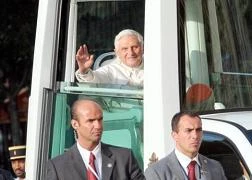
The final Mass, which was held on the meadow adjacent to the Shrine of Lourdes, commenced shortly after Pope Benedict made his way through the crowd in his popemobile.

"On this day when the Church's liturgy celebrates the feast of the Exaltation of the Holy Cross", he said in his homily, "the Gospel you have just heard reminds us of the meaning of this great mystery: ... The Son of God became vulnerable, assuming the condition of a slave, obedient even to death, death on a cross. By His Cross we are saved.

"The instrument of torture, which on Good Friday manifested God's judgment on the world, has become a source of life, pardon, mercy, a sign of reconciliation and peace,” the Pope stated. ... The Church invites us ... to give thanks to God because from a tree which brought death, life has burst out anew."

"It is significant," he observed, "that during the first apparition to Bernadette Mary begins the encounter with the sign of the Cross," this is "an initiation into the mysteries of the faith that Bernadette receives from Mary. The sign of the Cross is a kind of synthesis of our faith, ... it tells us that there is a love in this world that is stronger than death. ... The power of love is stronger than the evil which threatens us. It is this mystery of the universality of God's love for men that Mary came to reveal here, in Lourdes."

"The Church has received the mission of showing all people this loving face of God, manifested in Jesus Christ. ... It is He Who will make us free to love as He loves us, and to build a reconciled world. For on this Cross, Jesus took upon Himself the weight of all the sufferings and injustices of our humanity. He bore the humiliation and the discrimination, the torture suffered in many parts of the world by so many of our brothers and sisters for love of Christ."

The celebration of the anniversary of the apparitions of Our Lady in Lourdes, said the Holy Father, "urges us to embark upon a journey of faith and conversion. Today, Mary comes to meet us, so as to show us the way towards a renewal of life for our communities and for each one of us."

"Jesus, born of Mary, is the Son of God, the sole Savior of all people, living and acting in His Church and in the world. The Church is sent everywhere in the world to proclaim this unique message and to invite people to receive it through an authentic conversion of heart. This mission, entrusted by Jesus to His disciples, receives here, on the occasion of this Jubilee, a breath of new life."

Following the Jubilee Way in the footsteps of Bernadette, "we are reminded of the heart of the message of Lourdes. Bernadette is the eldest daughter of a very poor family, with neither knowledge nor power, and in poor health. Mary chose her to transmit her message of conversion, prayer and penance, which fully accord with words of Jesus: 'What you have hidden from the wise and understanding, you have revealed to babes'. ... It is therefore a genuine catechesis that is being proposed to us in this way, under Mary's gaze."

When the "beautiful lady" revealed her name to Bernadette - "I am the Immaculate Conception" - she disclosed "the extraordinary grace that she has received from God. ... Mary is the woman from this earth who gave herself totally to God, and who received the privilege of giving human life to His eternal Son."

"She is beauty transfigured, the image of the new humanity. By presenting herself in this way, in utter dependence upon God, Mary expresses in reality an attitude of total freedom, based upon the full recognition of her true dignity.

"This privilege," the Pope added, "concerns us too, for it discloses to us our own dignity as men and women, admittedly marked by sin, but saved in hope, a hope which allows us to face our daily life."

"The primary purpose of the shrine at Lourdes is to be a place of encounter with God in prayer and a place of service to our brothers and sisters, notably through the welcome given to the sick, the poor and all who suffer. In this place, Mary comes to us as a mother. ... Through the light which streams from her face, God's mercy is made manifest. ... Mary comes to remind us that prayer ... must have a central place in our Christian lives. Prayer is indispensable if we are to receive Christ's power."

Benedict XVI then went on to note that "the presence of young people at Lourdes is also an important element. ... When Mary received the angel's visit, she was a young girl from Nazareth leading the simple and courageous life typical of the women of her village. And if God's gaze focused particularly upon her, trusting in her, Mary wants to tell you once more that not one of you is indifferent in God's eyes. ... Mary was ... conscious of her frailty in the face of God's omnipotence. Nevertheless, she said 'yes', without hesitating. And thanks to her yes, salvation came into the world, thereby changing the history of mankind."

"Mary's message is a message of hope for all men and women of our day, whatever their country of origin," the Holy Father concluded. "I like to invoke Mary as the 'star of hope' ... who enlightens us and gives direction to our journey. Through her 'yes,' through the generous gift of herself, she has opened up to God the gates of our world and our history. And she invites us to live ... in invincible hope, refusing to believe those who claim that we are trapped in the fatal power of destiny."

Copyright @ CNA
(http://www.catholicnewsagency.com)

Men becoming priests at mid-life

Full article here.

Men becoming priests at mid-life

Father Michael Bies stands outside the entrance to St. Marys Catholic Church in Pontiac. The Pantagraph/STEVE SMEDLEY

Saturday, September 13, 2008 9:54 PM CDT

By Bob Holliday
bholliday@pantagraph.com

BLOOMINGTON -- In what he calls his past life, the Rev. Geoffrey Horton worked at a Bloomington-Normal insurance company, coached a women’s softball team, owned a home and invested in a 401K.
Although life was good, Horton, 43, felt something was missing. In May, he found his calling as a newly ordained Roman Catholic priest.
“I became a priest for the only reason anyone should ever become a priest, because I felt that’s what God was asking of me,” said Horton, currently assigned at a church in Peoria.
The Rev. Michael Bies heard the same call, but before he did, he worked 20 years as a machinist in his native Chicago and even considered marriage. Ordained about four years ago, Bies, 52, is associate pastor of St. Mary’s Church in Pontiac.
The two Central Illinois men aren’t alone in making such monumental mid-life career changes.
Paul Sullins, a professor at the Catholic University of America, said the average age at ordination has risen by 10 to 15 years since the 1970s — part of a national trend toward increased education and later-life commitments.
“An increasing proportion of priests today are entering their second or third careers,” said Sullins, adding the trend may help relieve the shortage of priests in the U.S.
Monsignor Paul Showalter, vicar general of the Peoria Diocese, agreed. Showalter said, in general, the trend toward older priests is beneficial.
It all comes down to “when they get the calling,” he said.
Horton and Bies both agreed their life experience can help them be better priests.
Bies, for instance, can identify first-hand with parishioners who are out of work
because he was without a job several times as a machinist.
Horton, likewise, hopes his experience in the corporate world gives him more empathy for parishioners stressed out by everyday business life.
Horton is unique in another way, having been an Episcopalian until he was 36.
The switch in religions together with his mid-life career switch doesn’t bother Horton’s mother, Johanna Horton of Jacksonville. “It seems right,” she said, adding her son has always had deep religious feelings.
However, there can be aspects of the mid-life switch that aren’t easy.
Hardest for Bies was giving up some of his independence. As a priest, he’s bound to his parish and that “takes a bit of getting used to,” he said.
Knowing that “God is using you to bring solace and peace,” helps him cope, he said.
The celibacy requirement is actually a gift, said Bies, because it “frees you up to see all people as part of your family.”
Bies has adapted to the St. Mary’s family well, said Monsignor Thomas Mack, the pastor there.
“People like him a lot. I’m not sure if it’s his maturity or just that he’s a nice guy,” said Mack, 57, who came to the priesthood the more traditional way: He was ordained in his mid-20s.
“It all comes down to when you get the call,” said Mack, agreeing that priests ordained later in life bring with them a maturity that helps them better relate to people.
John Steffen, 36, who worked this summer with Bies and Mack at St. Mary’s, may become another mid-life priest.
Steffen has four more years of seminary in Ohio and hopes his background in teaching and law will help him. He taught English for five years at Streator Township High School and worked at the Pontiac law firm of Caughey, Legner and Freehill.
He converted to Catholicism from Apostolic Christian as an adult. His new religion, he said, struck a chord he couldn’t ignore.
He, too, thinks older priests, because of their life experience, may have more to offer.
It’s that maturity that leads Horton to realize there’s no going back.
“It (being a priest) is not just your job, it’s your personal identity,” said Horton, who surprised at least one former co-worker by his mid-life switch.
“That switch (from actuarial work to priesthood) is like a 180-degree turn,” said Lisa Mullen, who played on the softball team Horton coached at Country Financial.

Copyright © 2008, Pantagraph Publishing Co. All rights reserved.

Tuesday, September 09, 2008

REFLECTION: On Labor Day, Human Work Made New - Catholic Online

By Deacon Keith A. Fournier
8/31/2008

Catholic Online (www.catholic.org)

In the United States we celebrate the first Monday of September as Labor Day. It is a day to reflect and relax.The Catholic Church proclaims the dignity, meaning and redemptive value of all human work.
"Work is for man, not man for work. Everyone should be able to draw from work the means of providing for his life and that of his family, and of serving the human community. The primordial value of labor stems from man himself, its author and beneficiary. By means of his labor man participates in the work of creation. Work united to Christ can be redemptive."

CHESAPEAKE, Va. (Catholic Online) - During the last years of his service to the Church and the world, the late, beloved Servant of God John Paul II addressed an assembly of the leaders of the “Catholic Action” movement in Italy on the Feast of St. Joseph the Worker. He used an extraordinary term, referring to what he called the “gospel of work”. I wrote an article on this address years ago. Sadly, I heard from some Protestant Christians who misunderstood the theme, thinking that the Holy Father was speaking of “works”. Nothing could have been more inaccurate. Rather, he was proclaiming a deeper meaning of the effects of grace on the entirety of our human experience; that in and through Jesus Christ, all human work has been transformed.
In proclaiming this gospel of work, John Paul developed a theme that is rooted in the Sacred Scriptures, expounded upon at length in the Christian Tradition and is desperately needed in this age. In 1981 he authored an Encyclical letter entitled “On Human Work” which beautifully presented this Christian vision of the dignity and meaning of human work. We live in an age that has all but lost this Christian vision of the meaning of work. This is not a new problem. It is a part of a larger social and individual malady, a bad fruit of the rupture of human integrity and solidarity wrought by sin.

Voter's Guide for Serious Catholics

PDF Version is here.

From the voter's guide...

"How this Voter's Guide Helps You

If you take your Catholic faith seriously then this voter's guide is for you.  It will help you cast your vote in an informed manner consistent with Catholic moral teaching and fundamental human rights.  This guide will help you tell the difference between candidates' positions that are morally acceptable and ones that are so contrary to fundamental moral principle that they are inconsistent with public service.

...

As the Holy See has pointed out: "Democracy must be based on the true and solid foundation of non-negotiable ethical principles, which are the underpinning of life in society" (CPL 3)."

Monday, September 08, 2008

Pelosi Continues to Roil Bishops

Find original text and attributes at, The Crossroads Initiative.

September 4th, 2008 by Catholic League

Saint AugustineOn August 24, House Speaker Nancy Pelosi told Tom Brokaw on NBC’s “Meet the Press” that the Catholic Church has not been able to decide when life begins; she was quickly criticized by many bishops and lay Catholics (including the Catholic League) for misrepresenting the Church’s teaching. No source of criticism was more important than that of the United States Conference of Catholic Bishops (USCCB).

Three days later, Pelosi’s office issued a statement acknowledging that the Church teaches that life begins at conception. However, it also said that St. Augustine offered a different perspective and opined that “many Catholics do not ascribe to that [the Church’s] view.”

Yesterday, the USCCB issued another statement (see below): it is a two-page reply that offered a historical account of the Catholic Church’s teaching on abortion. The release makes it clear that the Church has always been unequivocally opposed to abortion. The new statement was written to “help end confusion caused by recent misrepresentations of Catholic Church teaching on abortion,” a process that was “prompted by misleading remarks by Speaker of the House Nancy Pelosi.”

Bill DonahueCatholic League president Bill Donohue weighed in as follows:

“Nancy Pelosi continues to give currency to the idea that the Church’s teaching on abortion has evolved over time, and that in any case there is more than one legitimate Catholic position on this subject. She is twice wrong. It is precisely because of people like Morton Kondracke of the Fox News Channel, Anthony Stevens-Arroyo of the Newsweek-Washington Post ‘On Faith’ blog site, and anti-Catholic groups such as Catholics for Choice, that the confusion continues to rage. All of them defend Pelosi’s ignorant remarks.

“Nineteen Catholic members of the House have publicly asked Pelosi to ‘correct the public record’ on this issue. Her steadfast refusal to do so is keeping this matter alive. One wonders what it will take to get her to retract her comments before more damage is done to the Catholic Church, to her and to the Democratic Party.”


Respect for Unborn Human Life: The Church’s Constant TeachingFact sheet by the USCCB Committee on Pro-Life Activities. Click here to print as a PDF.
The Catechism of the Catholic Church states: “Since the first century the Church has affirmed the moral evil of every procured abortion. This teaching has not changed and remains unchangeable. Direct abortion, that is to say, abortion willed either as an end or a means, is gravely contrary to the moral law” (No. 2271).

In response to those who say this teaching has changed or is of recent origin, here are the facts:

  • From earliest times, Christians sharply distinguished themselves from surrounding pagan cultures by rejecting abortion and infanticide. The earliest widely used documents of Christian teaching and practice after the New Testament in the 1st and 2nd centuries, the Didache (Teaching of the Twelve Apostles) and Letter of Barnabas, condemned both practices, as did early regional and particular Church councils.
  • To be sure, knowledge of human embryology was very limited until recent times. Many Christian thinkers accepted the biological theories of their time, based on the writings of Aristotle (4th century BC) and other philosophers. Aristotle assumed a process was needed over time to turn the matter from a woman’s womb into a being that could receive a specifically human form or soul. The active formative power for this process was thought to come entirely from the man – the existence of the human ovum (egg), like so much of basic biology, was unknown.
  • However, such mistaken biological theories never changed the Church’s common conviction that abortion is gravely wrong at every stage. At the very least, early abortion was seen as attacking a being with a human destiny, being prepared by God to receive an immortal soul (cf. Jeremiah 1:5: “Before I formed you in the womb, I knew you”).
  • In the 5th century AD this rejection of abortion at every stage was affirmed by the great bishop-theologian St. Augustine. He knew of theories about the human soul not being present until some weeks into pregnancy. Because he used the Greek Septuagint translation of the Old Testament, he also thought the ancient Israelites had imposed a more severe penalty for accidentally causing a miscarriage if the fetus was “fully formed” (Exodus 21: 22-23), language not found in any known Hebrew version of this passage. But he also held that human knowledge of biology was very limited, and he wisely warned against misusing such theories to risk committing homicide. He added that God has the power to make up all human deficiencies or lack of development in the Resurrection, so we cannot assume that the earliest aborted children will be excluded from enjoying eternal life with God.
  • In the 13th century, St. Thomas Aquinas made extensive use of Aristotle’s thought, including his theory that the rational human soul is not present in the first few weeks of pregnancy. But he also rejected abortion as gravely wrong at every stage, observing that it is a sin “against nature” to reject God’s gift of a new life.
  • During these centuries, theories derived from Aristotle and others influenced the grading of penalties for abortion in Church law. Some canonical penalties were more severe for a direct abortion after the stage when the human soul was thought to be present. However, abortion at all stages continued to be seen as a grave moral evil.
  • From the 13th to 19th centuries, some theologians speculated about rare and difficult cases where they thought an abortion before “formation” or “ensoulment” might be morally justified. But these theories were discussed and then always rejected, as the Church refined and reaffirmed its understanding of abortion as an intrinsically evil act that can never be morally right.
  • In 1827, with the discovery of the human ovum, the mistaken biology of Aristotle was discredited. Scientists increasingly understood that the union of sperm and egg at conception produces a new living being that is distinct from both mother and father. Modern genetics demonstrated that this individual is, at the outset, distinctively human, with the inherent and active potential to mature into a human fetus, infant, child and adult. From 1869 onward the obsolete distinction between the “ensouled” and “unensouled” fetus was permanently removed from canon law on abortion.
  • Secular laws against abortion were being reformed at the same time and in the same way, based on secular medical experts’ realization that “no other doctrine appears to be consonant with reason or physiology but that which admits the embryo to possess vitality from the very moment of conception” (American Medical Association, Report on Criminal Abortion, 1871).
  • Thus modern science has not changed the Church’s constant teaching against abortion, but has underscored how important and reasonable it is, by confirming that the life of each individual of the human species begins with the earliest embryo.
  • Given the scientific fact that a human life begins at conception, the only moral norm needed to understand the Church’s opposition to abortion is the principle that each and every human life has inherent dignity, and thus must be treated with the respect due to a human person. This is the foundation for the Church’s social doctrine, including its teachings on war, the use of capital punishment, euthanasia, health care, poverty and immigration. Conversely, to claim that some live human beings do not deserve respect or should not be treated as “persons” (based on changeable factors such as age, condition, location, or lack of mental or physical abilities) is to deny the very idea of inherent human rights. Such a claim undermines respect for the lives of many vulnerable people before and after birth.

For more information: Congregation for the Doctrine of the Faith, Declaration on Procured Abortion (1974), nos. 6-7; John R. Connery, S.J., Abortion: The Development of the Roman Catholic Perspective (1977); Germain Grisez, Abortion: The Myths, the Realities, and the Arguments (1970), Chapter IV; U.S. Conference of Catholic Bishops, On Embryonic Stem Cell Research (2008); Pope John Paul II, Evangelium Vitae (1995), nos. 61-2.

Downloadable PDF provided by The Crossroads Initiative -- download here.